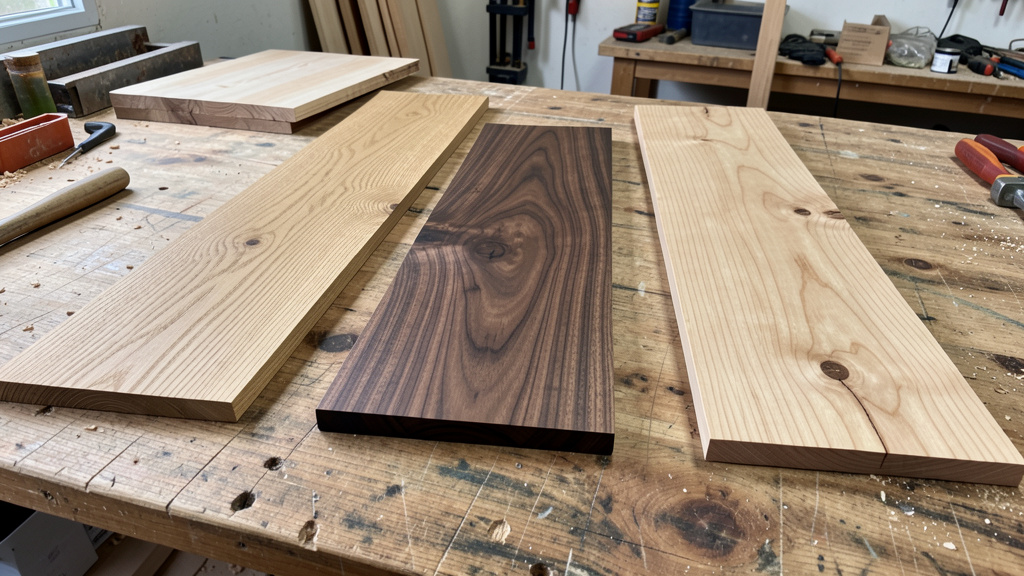
Stop guessing which wood to use. This guide breaks down over 25 wood species by hardness, grain, workability, cost, and ideal applications—with actionable frameworks to help match your project to a suitable material.
Choosing an unsuitable wood can compromise even carefully crafted projects. A dining table made from dimensionally unstable wood may develop gaps with seasonal humidity shifts. Outdoor furniture crafted from non-resistant species may deteriorate prematurely. Children’s toys carved from splinter-prone material raise safety concerns. This guide reduces common selection risks by transforming wood choice from overwhelming guesswork into a structured, repeatable process. We synthesize established material science references, historical woodworking knowledge, and documented project considerations into a practical resource. Whether you’re building furniture, installing flooring, designing outdoor structures, or carving details, you’ll find guidance to align wood properties with your project’s functional needs, aesthetic goals, and values—presented with clarity and context.
Introduction: Why Wood Selection Is the Unseen Foundation of Every Project
Wood is not a uniform commodity. It is a biological material shaped by species, geography, growth conditions, and milling practices. Two boards from the same log may behave differently based on heartwood versus sapwood origin, grain orientation, or environmental exposure during the tree’s life. This natural variability contributes to wood’s character—and underscores why thoughtful selection matters.
For generations, experienced woodworkers developed intuition through repeated practice: reading grain direction before cutting, assessing moisture by feel, observing how finishes interact with surface texture. Today, standardized references like the Janka hardness scale, moisture content guidelines, and sustainability certifications complement this hands-on wisdom. Yet modern complexities remain: global supply chains can obscure origins, marketing terms like “premium hardwood” lack universal definition, and environmental considerations require informed decisions.
This guide bridges foundational craftsmanship principles with contemporary practicality. We move beyond simple species lists to teach how to evaluate wood for your specific context. You’ll learn to translate project requirements into material properties, anticipate seasonal movement, avoid documented pitfalls shared across woodworking communities, and make choices that balance function, aesthetics, and responsibility. Wood selection practices draw from centuries of empirical knowledge, while modern frameworks from organizations like the Forest Stewardship Council (FSC) and the American Hardwood Export Council offer transparent benchmarks for quality and stewardship—supporting creations that endure while honoring resource origins.
The Project-First Framework: Your Systematic Path to Confident Wood Selection
Memorizing every wood property is inefficient. Instead, adopt a repeatable decision process applicable to any project. This three-step framework, developed from established woodworking principles and common project requirements, transforms ambiguity into clarity. Apply it before selecting materials.
Step 1: Define Your Project’s Non-Negotiable Requirements
Begin with four precise questions. Write down answers—vague intentions often lead to mismatched materials.
-
Primary Function & Stress Points: Will the piece bear weight (shelves, table legs)? Experience abrasion (flooring, cutting boards)? Require fine detail retention (carving, inlay)? Face impact (tool handles, children’s toys)?
Why it matters: A jewelry box prioritizes fine-detail retention; a workshop bench demands impact resistance. Confusing these leads to frustration.
Common nuance: “Strength” has multiple meanings. Structural strength (resisting breakage) differs from surface hardness (resisting dents). Ash excels in bending strength but may show surface dents more readily than maple. -
Environmental Exposure: Will it face moisture (bathroom shelf, outdoor bench)? Direct sunlight (south-facing windowsill)? Temperature swings (unheated garage)? Soil contact (garden bed)?
Why it matters: Wood expands in humidity and contracts in dry conditions. Moisture accelerates decay in non-resistant species. UV exposure fades color over time.
Illustrative example: A porch swing built from untreated pine showed significant cupping and cracking after repeated rain exposure. Rebuilding with pre-finished cedar and stainless steel hardware extended service life substantially with routine maintenance. -
Aesthetic Intent: Do you want prominent grain (rustic farmhouse table)? Uniform color (painted cabinet)? Specific hue (matching existing furniture)? Natural aging (cherry’s patina)?
Why it matters: Woods absorb finishes differently. Maple may blotch with liquid stain; pine requires conditioner. Open-grained woods like oak often need filler for glass-smooth painted surfaces.
Practical note: Using highly figured walnut for a painted cabinet may not leverage its visual character efficiently. Poplar often delivers comparable painted results at lower cost and with greater consistency. -
Practical Constraints: What is your realistic budget per board foot? Skill level (beginner-friendly vs. demanding species)? Tool capability (carbide-tipped blades for dense hardwoods)? Local availability?
Why it matters: Exotic woods may require specialized tools or finishing techniques. Shipping costs and lead times affect feasibility.
Consideration: “Budget” includes hidden factors: time spent sanding difficult woods, potential finish corrections, or premature replacement due to species mismatch.
Step 2: Translate Requirements into Material Properties
Map your answers to objective wood characteristics. Use this reference table as your decoding key:
| Project Requirement | Critical Wood Properties | Properties to Approach Cautiously | Why This Matters |
|---|---|---|---|
| Outdoor Exposure (uncovered) | Natural rot resistance, dimensional stability | Low-density woods, high sap content | Moisture absorption contributes to swelling, warping, and decay. Stability supports joint integrity over time. |
| High-Traffic Flooring | Janka hardness >1,000 lbf, tight grain | Open grain (traps dirt), very soft woods | Hardness helps resist dents. Tight grain cleans more easily and wears uniformly. |
| Fine Furniture (visible) | Workability, finishing quality, grain figure | Inconsistent color, highly interlocked grain | Smooth machining supports crisp joinery. Predictable finishing contributes to professional results. |
| Carving/Whittling | Straight grain, moderate softness | Brittle woods, irregular grain patterns | Straight grain cuts cleanly. Moderate softness holds detail without excessive splintering. |
| Painted Cabinetry | Uniform texture, minimal knots | Highly figured woods, resin pockets | Smooth surface accepts paint evenly. Knots may bleed through light paints without proper priming. |
| Structural Framing | Strength-to-weight ratio, straight grain | Twisted grain, excessive knots | Straight grain supports load-bearing capacity. Consistency aids predictable engineering. |
| Food Contact Surfaces | Closed grain, non-toxic finish compatibility | Open grain (harbors moisture), toxic oils | Closed grain resists moisture absorption. Safety considerations are essential. |
| Humid Environments (bath) | Dimensional stability, moisture resistance | Woods prone to swelling/checking | Stability helps prevent doors from sticking or gaps forming in cabinetry over seasons. |
How to apply this framework:
Imagine building a kitchen cutting board.
– Function: Knife impact, moisture exposure, food safety → Requires closed grain, adequate hardness, smooth finish potential.
– Environment: Frequent washing, humidity → Needs stability and finish compatibility.
– Aesthetics: Warm tone preferred → Rules out very light or very dark extremes.
– Constraints: Beginner-friendly, under $50 for materials.
Translation: Hard maple is frequently chosen (Janka ~1,450 lbf, closed grain, light color). Walnut is beautiful but softer (~1,010 lbf) and more porous. Bamboo is hard but laminated edges may delaminate with repeated moisture exposure if not high-quality. This logical mapping supports intentional choices over impulse.
Step 3: Validate Against Real-World Practicalities
Even theoretically suitable wood may present practical challenges. Conduct this final checkpoint:
- Moisture Content Verification: Use a reliable moisture meter. Common target ranges:
- Interior projects: 6–8% moisture content (MC)
-
Exterior projects: 9–12% MC (adjust for local climate)
Key insight: Wood purchased at higher MC in a humid environment will shrink after moving to a drier workshop, potentially causing cracks or joint gaps. Acclimating wood in your project environment for 7–14 days before milling is widely recommended. Many woodworking resources note that unverified moisture content is a frequent contributor to unexpected movement. -
Sustainability & Ethics Consideration:
- Look for FSC (Forest Stewardship Council) or PEFC (Programme for the Endorsement of Forest Certification) labels where available.
- For tropical species (mahogany, teak), inquire about documentation of legal harvest. CITES restrictions apply to rosewood, ebony, and others.
-
Consider domestic alternatives: Black walnut instead of tropical rosewood for accents; white oak instead of teak for outdoor projects (with appropriate finish and maintenance).
Why this matters: Responsible sourcing supports forest health and community well-being. Ethical choices also align with evolving regulations and long-term material availability. -
Local Availability Check:
Contact local suppliers. Ask: “Do you regularly stock [species] in [dimensions]?” If not, factor in shipping costs, lead times, and potential batch variation. A maker in a mountain region found that shipping a tropical species exceeded material costs—switching to locally abundant aspen (with suitable finish) reduced expense and environmental impact.
The Fundamental Principle: The most suitable wood aligns reliably with your project’s core functional requirements within your practical constraints of budget, skill, ethics, and environment. When function guides selection, aesthetic results often follow through thoughtful execution.
Hardwood Species Deep Dive: Precision Profiles for Discerning Makers
Hardwoods originate from deciduous trees (broadleaf, seasonal leaf loss). Despite the name, hardness varies widely—balsa is botanically a hardwood yet softer than many softwoods. These species are often selected where density, grain character, or finishing quality are priorities. Each profile includes observable traits and practical considerations drawn from woodworking references and community experience.
Oak (Quercus spp.): The Timeless Structural Anchor
Origin & Availability: Red Oak (Quercus rubra) and White Oak (Quercus alba) are widely available across North America and Europe. White Oak typically carries a modest premium due to enhanced moisture resistance.
Visual Identification:
– Red Oak: Pinkish-tan heartwood, coarse open grain with visible ray flecks. Sapwood nearly white.
– White Oak: Light to medium brown with olive undertones. Tighter grain than Red Oak; distinctive “tiger stripe” figure when quartersawn.
Janka Hardness (approx.): Red Oak: 1,290 lbf | White Oak: 1,360 lbf
Workability Notes:
– Machines cleanly with sharp carbide blades; dulls steel tools relatively quickly.
– Open grain often benefits from filling for smooth finishes (oil-based grain filler before staining is common).
– Sands well through progressive grits (80→120→180). Skipping grits may leave swirl marks in pores.
– Glues reliably with PVA or epoxy. Pre-drilling recommended near edges for fasteners.
Durability & Stability:
– White Oak: Contains tyloses (natural cell blockages), contributing to liquid resistance. Historically used for barrels, ship components, and water tanks. Good natural rot resistance.
– Red Oak: Lacks tyloses; absorbs moisture readily. Not recommended for prolonged wet exposure.
– Both exhibit moderate seasonal movement. Acclimation is essential.
Cost Tier: $$ (Red Oak) | $$$ (White Oak)
Common Applications:
– Red Oak: Stained furniture, interior trim, cabinetry, gym flooring (in dry environments).
– White Oak: Outdoor furniture (with marine-grade finish), boatbuilding components, flooring in kitchens/bathrooms, Mission-style furniture.
Practical Note: Substituting Red Oak for White Oak in moisture-prone settings is generally discouraged. For outdoor use, spar urethane (not standard polyurethane) is often recommended, with periodic re-coating per manufacturer guidance.
Maple (Acer saccharum): The Uncompromising Performance Standard
Origin & Availability: Sugar Maple (Hard Maple) is native to North America. Widely available as dimensional lumber, flooring blanks, and butcher block stock. Figured variants (birdseye, curly) command higher prices.
Visual Identification: Creamy white to light reddish-brown. Grain typically straight but may feature:
– Birdseye: Tiny swirling patterns.
– Curly: Wavy grain creating chatoyance (shimmer under light).
– Quilted: Three-dimensional ripple (less common).
Janka Hardness (approx.): 1,450 lbf
Workability Notes:
– Very hard on cutting edges; sharp carbide-tipped blades recommended.
– Sands to a smooth finish. Progress slowly through grits to avoid burning (maple gums with heat).
– May blotch with liquid stains due to uniform density. Common solutions:
– Gel stain (sits on surface)
– Pre-stain conditioner
– Dye + clear topcoat for even color
– Takes paint exceptionally well—ideal for crisp white cabinets.
Durability & Stability:
– High abrasion resistance (common for basketball courts).
– Closed grain supports food-safe applications when properly finished.
– Moderate stability when properly dried and acclimated.
Cost Tier: $$ (plain) | $$$$ (premium figured)
Common Applications: Butcher blocks, cutting boards, high-traffic flooring, workbenches, painted cabinetry, musical instruments (drum shells), contemporary furniture.
Practical Note: Density makes hand-planing challenging for beginners. Figured maples often require climb-cutting on routers to minimize tear-out. For cutting boards, end-grain construction helps protect knife edges and allows minor cuts to “self-heal.”
Cherry (Prunus serotina): The Living Patina Masterpiece
Origin & Availability: Black Cherry native to Eastern North America. Widely available; wide, clear boards (>12″ width) are less common and higher cost.
Visual Identification: Freshly milled heartwood is light pinkish-brown. Sapwood is pale yellow (often excluded in premium grades). Grain is smooth, straight, and fine.
The Patina Process:
– Weeks 1–4: Lightens slightly after sanding.
– Months 1–6: Deepens to warm reddish-amber.
– Years 1–5: Rich russet-brown with golden highlights. UV exposure accelerates change.
Tip: Wiping with denatured alcohol temporarily mimics aged color—helpful for previewing.
Janka Hardness (approx.): 950 lbf
Workability Notes:
– Machines and sands with exceptional ease. Holds fine details well.
– Natural oils complement finishing—often requires only tung oil or paste wax for luster.
– Glues strongly with PVA. Minimal pre-drilling needed for screws.
– Water-based finishes may raise grain initially; sealing first with dewaxed shellac is a common practice.
Durability & Stability: Moderate rot resistance. Stable when kiln-dried to target MC. Seasonal movement is generally predictable.
Cost Tier: $$$
Common Applications: Heirloom furniture, decorative veneers, turned objects, musical instruments, library paneling. Ideal where graceful aging is part of the design intent.
Practical Note: UV light causes uneven darkening. When matching existing cherry furniture, account for age difference—new wood will darken toward older pieces over time. Not recommended for high-abrasion surfaces like flooring. For consistent color across a project, sourcing boards from the same flitch (log section) is advisable.
Walnut (Juglans nigra): The Dramatic Contrast Artist
Origin & Availability: North American Black Walnut is widely recognized. Demand has increased prices; verify sourcing practices. African Walnut (Lovoa trichilioides) is a lighter, less expensive alternative with different characteristics.
Visual Identification: Heartwood ranges from rich chocolate brown to purplish-black with lighter gray streaks. Sapwood is pale yellow (often 2–4″ wide)—premium grades typically exclude it. Grain is usually straight but can be wavy or curly. Polishes to deep luster.
Janka Hardness (approx.): 1,010 lbf
Workability Notes:
– Machines cleanly with sharp tools. Minimal tear-out even on figured sections.
– Sands exceptionally well—progress to 220 grit for silky feel.
– Stain is rarely needed; oils or lacquers enhance natural depth.
– Dust may cause sensitivity in some individuals—respiratory protection during sanding is prudent.
Durability & Stability: Good rot resistance. Stable when properly dried. Dark color helps mask minor surface wear.
Cost Tier: $$$$
Common Applications: Accent pieces, high-end furniture, gunstocks, veneers, carving, luxury cabinetry. Adds visual weight and sophistication.
Practical Note: Sapwood inclusion affects yield—factor extra material into estimates. Prolonged direct sunlight may fade color over time. For mixed-wood projects (e.g., walnut accents on maple), applying finish to all components simultaneously helps prevent color drift during curing.
Ash (Fraxinus spp.): The Resilient Shock Absorber
Origin & Availability: White Ash (Fraxinus americana) was historically abundant. Emerald Ash Borer infestation has significantly reduced supply—availability varies regionally. Verify local sources; consider alternatives like hickory or oak where appropriate.
Visual Identification: Light tan to pale brown. Grain is pronounced, straight, and porous—visually similar to oak but lighter in color and weight.
Janka Hardness (approx.): White Ash: 1,320 lbf
Workability Notes:
– Excellent steam-bending properties (retains shape after cooling).
– Machines cleanly but open grain often benefits from filling for smooth finishes.
– Holds fasteners well. Glues strongly.
– Interlocked grain sections may cause tear-out—sharp blades and controlled feed rates help.
Durability & Stability: Low natural rot resistance. Moderate stability. Avoid outdoor use without rigorous sealing and maintenance.
Cost Tier: $$ (but variable due to scarcity)
Common Applications: Tool handles, baseball bats, Windsor chair parts, bent laminations, electric guitar bodies. Valued where shock absorption matters.
Practical Note: Due to pest impacts, prioritize suppliers with transparent sourcing. For bending projects, steaming guidelines vary by thickness and equipment—consult trusted woodworking references.
Birch (Betula spp.): The Reliable Paint-Grade Performer
Origin & Availability: Yellow Birch (Betula alleghaniensis) common in North America/Europe. Extremely prevalent as plywood core and dimensional lumber.
Visual Identification: Pale white to light reddish-brown. Grain is fine, uniform, and subtle—often described as “neutral.” Sapwood and heartwood similar in color.
Janka Hardness (approx.): Yellow Birch: 1,260 lbf
Workability Notes:
– Machines and sands smoothly with minimal tear-out.
– May blotch with liquid stains—pre-stain conditioner or gel stain is commonly used.
– Takes paint exceptionally well; minimal grain telegraphing.
– Glues strongly; ideal for laminations.
Durability & Stability: Low rot resistance. Moderate stability when dry.
Cost Tier: $
Common Applications: Painted cabinets, furniture frames (hidden carcasses), drawer boxes, children’s furniture, plywood substrates, jigs and fixtures. Economical where appearance is secondary to function.
Practical Note: Plain appearance may not suit natural finishes where grain character is desired. Often confused with maple—but birch is less dense, has subtle grain lines, and may yellow slightly with age. For painted projects, sealing end grain helps prevent moisture absorption at joints.
Poplar (Liriodendron tulipifera): The Strategic Budget Ally
Origin & Availability: Eastern North America. One of the most affordable and widely stocked hardwoods. Often labeled “tulip poplar” or “yellow poplar” (not a true poplar).
Visual Identification: Heartwood ranges from greenish-gray to brown; sapwood is creamy white. Significant color variation between boards is normal. Grain is straight and fine.
Janka Hardness (approx.): 540 lbf
Workability Notes:
– Extremely easy to cut, shape, and sand—even with hand tools.
– Holds paint and glue superbly. Minimal warping during drying.
– Green streaks may bleed through light paints—stain-blocking primer is recommended.
– Sands quickly; avoid over-sanding soft areas.
Durability & Stability: Low rot resistance. Stable when kiln-dried.
Cost Tier: $
Common Applications: Painted furniture, cabinet carcasses, moldings, prototypes, hidden structural parts, beginner practice wood. Go-to for cost-conscious painted projects.
Practical Note: Not ideal for natural finishes expecting uniform color—the green/gray streaks are inherent. Too soft for tabletops, shelves, or high-wear surfaces. For children’s toys, seal thoroughly with non-toxic finish to minimize splinter risk.
Mahogany (Swietenia macrophylla and alternatives): The Benchmark of Refinement
Origin & Availability: Important clarification: “Genuine” Honduran Mahogany (Swietenia macrophylla) is CITES-listed and restricted. Most commercial “mahogany” is:
– African Mahogany (Khaya spp.): Sustainable plantation-grown alternative. Widely available.
– Philippine Mahogany (Shorea spp.): Actually a lauan—softer, less stable. Generally avoided for fine work.
Always verify species with supplier.
Visual Identification: Rich reddish-brown darkening with age. Grain straight, fine, often interlocked producing ribbon figure. Polishes to luxurious sheen.
Janka Hardness (approx.): Honduran: ~800 lbf | African: 900–1,100 lbf
Workability Notes:
– Cuts and carves with minimal tear-out. Sands to silkiness.
– Interlocked grain requires sharp tools and consistent feed direction.
– Accepts finishes readily—hand-rubbed oils (tung, linseed) enhance depth.
– Glues reliably with PVA or epoxy.
Durability & Stability: Good dimensional stability (minimal expansion/contraction). Good rot resistance, especially Honduran. Performs well in humid climates.
Cost Tier: $$$$ (Genuine) | $$$ (African)
Common Applications: High-end furniture, boatbuilding trim, musical instruments, veneers, restoration work, luxury cabinetry.
Practical Note: Sustainability is essential. Prioritize FSC-certified African Mahogany where functionally suitable. Avoid “Philippine Mahogany” for structural or visible parts—it’s prone to warping. Dust may cause respiratory irritation; wear protection.
Teak (Tectona grandis): The Unrivaled Outdoor Sovereign
Origin & Availability: Native to Southeast Asia. Now cultivated in plantations (India, Indonesia, Africa). Strict export controls exist—verify legal, sustainable sourcing. Reclaimed teak is an excellent eco-option.
Visual Identification: Golden to medium brown with dark grain streaks. Oily feel. Weathers to silvery-gray if left unfinished. Grain is coarse and straight.
Janka Hardness (approx.): 1,070 lbf
Workability Notes:
– Natural oils may gum blades—use carbide-tipped tools and clean frequently.
– Can be difficult to glue; epoxy or specialized adhesives are often recommended.
– Best finished with penetrating oil (pure tung or linseed oil). Film finishes (polyurethane) may peel due to oil content.
– Sand only to 150 grit; higher grits may close pores needed for oil absorption.
Durability & Stability: Exceptional natural resistance to rot, insects, moisture, and UV. Extremely stable—minimal movement. Contains silica, which dulls tools rapidly.
Cost Tier: $$$$
Common Applications: Boat decks, outdoor furniture, marine hardware, patio structures. Worth the investment for permanent outdoor installations with proper maintenance.
Practical Note: High cost reflects scarcity and ethical considerations. Avoid petroleum-based “teak oil”—it attracts dirt. Clean with mild soap and water; avoid pressure washers. For weathered gray finish, leave unfinished and clean annually. Reclaimed teak offers identical properties with lower environmental impact.
Hickory (Carya spp.): The Uncompromising Durability Champion
Origin & Availability: North America. Common but underutilized in furniture due to extreme hardness and dramatic color variation.
Visual Identification: Stark contrast between nearly white sapwood and light-to-medium brown heartwood. Grain is coarse, straight, and pronounced.
Janka Hardness (approx.): 1,820 lbf
Workability Notes:
– Very hard on tools; requires heavy-duty equipment and sharp carbide blades.
– Prone to splintering during machining—backing boards when crosscutting help.
– Sands laboriously; start coarse (60 grit) to level surface before refining.
– Glues well but requires adequate clamping pressure due to density.
Durability & Stability: Excellent rot resistance. However, higher seasonal movement (~0.2″ per foot width)—joinery that accommodates expansion (floating panels, elongated screw holes) is advisable.
Cost Tier: $$
Common Applications: Tool handles, ladder rungs, rustic furniture, workshop flooring, smoking wood. Ideal where extreme impact resistance is critical.
Practical Note: Not recommended for beginners. Density makes hand-tool work demanding. For furniture, embracing the rustic aesthetic (including sapwood contrast) reduces waste.
Beech (Fagus grandifolia): The European Craftsmanship Staple
Origin & Availability: Eastern North America and Europe. Very common in European woodworking; available globally as lumber, plywood, and steam-bent components.
Visual Identification: Pale cream to pinkish-brown. Grain straight, fine, and even—similar to maple but warmer tone. Often sold “steamed” (red beech) for uniform color.
Janka Hardness (approx.): 1,300 lbf
Workability Notes:
– Machines well but can burn with dull tools—keep blades sharp.
– Exceptional steam-bending properties (retains shape permanently).
– Takes stains and finishes uniformly. Sands smoothly.
– Glues strongly; ideal for laminations.
Durability & Stability: Low rot resistance. Moderate stability when dry. Susceptible to insect attack if stored improperly.
Cost Tier: $$
Common Applications: Bentwood chairs (Thonet-style), workbenches, veneers, food-safe items (in regions where approved), plywood cores, turned objects.
Practical Note: Not suitable for outdoors or damp environments. Steamed beech has slightly reduced strength but better color consistency. Bending guidelines vary—consult trusted references.
Alder (Alnus rubra): The Strategic Cherry Impersonator
Origin & Availability: Western North America. Increasingly popular as sustainable, affordable alternative to cherry.
Visual Identification: Light tan to reddish-brown. Grain subtle and uniform. Accepts stains exceptionally well to mimic cherry or mahogany.
Janka Hardness (approx.): 590 lbf
Workability Notes:
– Very easy to machine, carve, and sand. Minimal tool wear.
– Glues and finishes without issues.
– Color variation between boards can be significant—select boards together under consistent lighting.
– Blotching is minimal compared to pine; pre-stain conditioner still recommended for dark stains.
Durability & Stability: Low rot resistance. Stable when kiln-dried.
Cost Tier: $
Common Applications: Stained furniture (mimics cherry at lower cost), cabinetry, carvings, musical instruments, beginner projects. Ideal where budget constraints meet aesthetic goals.
Practical Note: Softness limits use to low-wear applications. Avoid for tabletops, shelves, or high-traffic areas. For natural finishes, multiple thin finish coats build durability.
Sapele (Entandrophragma cylindricum): The Ethical Mahogany Alternative
Origin & Availability: Tropical Africa. Widely available as sustainable plantation-grown alternative to genuine mahogany. FSC-certified sources common.
Visual Identification: Deep reddish-brown with distinctive ribbon-striped figure (due to interlocked grain). Darkens with age. Quartersawn cuts maximize figure.
Janka Hardness (approx.): 1,410 lbf
Workability Notes:
– Interlocked grain may cause tear-out during planing—sharp tools, slow feed rates, and climb-cutting on routers help.
– Sands well but requires patience on figured sections.
– Takes finishes beautifully; enhances figure with oil or lacquer.
– Dust may cause respiratory irritation—wear respirator.
Durability & Stability: Good rot resistance. Moderate stability. Performs reliably in varied climates.
Cost Tier: $$$
Common Applications: High-end furniture, veneers, musical instruments, boatbuilding trim, doors, paneling. Excellent where mahogany is desired but sustainability or cost is a concern.
Practical Note: Interlocked grain demands technique—practice on scraps first. Verify FSC certification. Not ideal for beginners due to tear-out risk.
Rosewood (Dalbergia spp.): The Acoustic and Artisan Treasure
Origin & Availability: Critical note: Many species (Brazilian, Honduran) are CITES Appendix I listed—international trade banned or severely restricted. Indian Rosewood (Dalbergia latifolia) is CITES Appendix II (regulated). Verify legality and documentation before purchase. African Blackwood (Dalbergia melanoxylon) is a sustainable alternative for small projects.
Visual Identification: Deep chocolate brown with dramatic black streaks. Grain dense and oily. Polishes to mirror-like finish. Emits faint rose-like scent when worked.
Janka Hardness (approx.): Brazilian Rosewood: ~2,790 lbf
Workability Notes:
– Very hard on tools; requires carbide. Oily nature complicates gluing—epoxy is often used.
– Best smoothed with scrapers rather than sandpaper for final finish.
– Prized for acoustic properties: resonant, sustain-rich tone.
– Dust is a known sensitizer—respirator and workshop ventilation are essential.
Durability & Stability: Exceptional rot and insect resistance. Very stable.
Cost Tier: $$$$$ (and often legally restricted)
Common Applications: Musical instrument fretboards, fine inlay work, luxury turnings, high-end knife handles, small decorative objects. Used sparingly due to cost, regulations, and ethical considerations.
Practical Note: Sustainability and legality are paramount. Seek certified alternatives like African Blackwood with documentation. Never purchase without verified paperwork. Dedicated tools for rosewood minimize cross-contamination risks.
Basswood (Tilia americana): The Carver’s Trusted Canvas
Origin & Availability: North America. Ubiquitous in carving supply stores and craft sections.
Visual Identification: Pale white to light brown. Grain exceptionally fine, straight, and uniform—almost invisible. Lightweight.
Janka Hardness (approx.): 410 lbf
Workability Notes:
– Cuts easily with knives, chisels, or power tools. Holds intricate detail without splintering.
– Sands effortlessly to glass-smooth surface.
– Accepts paint, stain, and pyrography (wood burning) evenly.
– Minimal tool wear—ideal for beginners learning techniques.
Durability & Stability: Low rot resistance. Stable when dry.
Cost Tier: $
Common Applications: Wood carving (relief, sculptures), model building, musical instrument soundboards, hidden furniture parts, beginner practice wood. Universal choice for detailed carving.
Practical Note: Too soft for functional items subject to wear (toys, handles). Avoid moisture exposure—swells and dents easily. For painted carvings, seal thoroughly before painting.
(Additional hardwoods commonly referenced: Butternut, Black Locust, Mesquite, Purpleheart, Padauk)
Softwood Species Deep Dive: Strength, Value, and Versatility Unleashed
Softwoods originate from coniferous trees (evergreens with needles). Despite the name, some (like Southern Yellow Pine) exceed many hardwoods in hardness. Prized for straight grain, affordability, workability, and structural performance. Essential for construction, outdoor projects, and budget-conscious builds.
Pine (Pinus spp.): The Universal Foundation Wood
Origin & Availability: Global species. Key types:
– Eastern White Pine (Pinus strobus): Soft, lightweight, minimal resin. Common in Northeast US/Canada.
– Southern Yellow Pine (Pinus spp.): Harder, resinous, strong. Dominates US construction south of Mason-Dixon line.
– Ponderosa Pine (Pinus ponderosa): Western US; similar to White Pine but slightly harder.
Always confirm species—properties vary.
Visual Identification: Heartwood light brown; sapwood nearly white. Grain straight with prominent knots (“knotty pine”) or minimal knots (select grades). Resin pockets visible as amber streaks.
Janka Hardness (approx.): Eastern White Pine: 380 lbf | Southern Yellow Pine: 870 lbf
Workability Notes:
– Easy to cut, nail, and sand with hand or power tools.
– Resin may gum blades—clean frequently with mineral spirits.
– Blotches severely with liquid stains. Common solutions:
– Gel stain
– Pre-stain conditioner
– Embrace rustic look with clear finish highlighting knots
– Takes paint well; prime knots to prevent bleed-through.
Durability & Stability: Low natural rot resistance (except heartwood of old-growth). Prone to dents and scratches. Moderate to high movement—allow expansion gaps in wide panels.
Cost Tier: $
Common Applications:
– Construction: Framing, sheathing, subflooring.
– DIY Projects: Shelves, crates, rustic furniture, children’s playhouses, workshop jigs.
– Crafts: Carving (for beginners), model building, holiday decorations.
Practical Note: “Pine” is not a single material. Southern Yellow Pine’s hardness and resin content make it less suitable for fine carving where White Pine excels. For outdoor use, only use pressure-treated (for ground contact) or naturally resistant species (cedar, redwood). Never use untreated pine for ground contact or constant moisture exposure.
Cedar (Thuja plicata / Juniperus virginiana): The Aromatic Guardian
Origin & Availability:
– Western Red Cedar (Thuja plicata): Pacific Northwest. Premium choice for outdoor projects.
– Eastern Red Cedar (Juniperus virginiana): Eastern US. Aromatic, often used for chests.
Both widely available; Western Red commands higher price.
Visual Identification:
– Western Red: Pinkish-red to deep brown. Straight grain. Weathers to silvery-gray.
– Eastern Red: Reddish-purple heartwood. Strong aromatic scent (moth-repellent).
Janka Hardness (approx.): Both ~900 lbf
Workability Notes:
– Soft and easy to work with hand or power tools. Straight grain cuts cleanly.
– Distinctive scent is pleasant but may irritate sensitive individuals—ensure ventilation.
– Oils may interfere with water-based finishes—test first. Oil-based finishes penetrate well.
– Nails and screws hold securely; pre-drill near edges to prevent splitting.
Durability & Stability: Excellent natural rot and insect resistance due to thujaplicin oils. Very stable—minimal warping. Western Red Cedar is a benchmark for outdoor durability.
Cost Tier: $$ (Western Red) | $ (Eastern Red)
Common Applications:
– Western Red: Outdoor furniture, fencing, siding, planters, saunas, boat trim.
– Eastern Red: Closet liners (moth resistance), hope chests, small carvings, aromatic projects.
Practical Note: Oils may inhibit adhesion of some finishes—always test on scrap. Not structural; use for non-load-bearing applications. Avoid direct ground contact even though rot-resistant (use concrete piers or metal brackets). For planters, lining interior with landscape fabric may slow soil contact degradation.
Redwood (Sequoia sempervirens): The Coastal Climate Specialist
Origin & Availability: Pacific Coast of North America. Old-growth harvesting restricted; plantation-grown is standard. Verify sustainable sourcing (look for “Sustainable Forestry Initiative” label).
Visual Identification: Heartwood salmon-pink to deep reddish-brown. Grain straight and fine. Sapwood pale yellow (avoid—lacks rot resistance). Weathers to silver-gray.
Janka Hardness (approx.): 450 lbf (Coast Redwood)
Workability Notes:
– Easy to work with sharp tools. Resists warping and splitting.
– Takes nails and screws well without pre-drilling (usually).
– Finishes beautifully with penetrating oil; film finishes may peel over time.
– Dust may cause allergic reactions in some—wear mask.
Durability & Stability: Exceptional rot and insect resistance due to tannins. Very stable. Performs exceptionally in humid, foggy climates.
Cost Tier: $$$
Common Applications: Decking, outdoor furniture, garden structures (arbors, trellises), siding in coastal/humid regions, raised garden beds. Preferred where maximum natural durability is needed without chemical treatment.
Practical Note: High cost reflects scarcity. Always specify “all-heart” or “clear heart” grade—sapwood lacks protective properties. For garden beds growing edibles, lining interior with a food-safe barrier is a common precaution (though redwood is generally considered safe for this use).
Spruce (Picea spp.): The Strength-to-Weight Specialist
Origin & Availability: Northern Hemisphere. Key types:
– Sitka Spruce (Picea sitchensis): Pacific Coast. Premier for musical instruments.
– Norway Spruce (Picea abies): Europe. Common in construction.
Widely available as dimensional lumber and specialty stock.
Visual Identification: Creamy white to pale yellow. Grain fine, straight, and even. Often indistinguishable from pine without close inspection (spruce has finer grain, fewer resin canals).
Janka Hardness (approx.): Sitka Spruce: 510 lbf
Workability Notes:
– Easy to work but can splinter—use sharp blades and backing boards.
– Good holding power for nails and screws.
– Takes paint well; minimal grain raising.
– Sands smoothly but requires care to avoid tear-out on irregular grain.
Durability & Stability: Low rot resistance. Moderate stability. Prone to surface checking (small cracks) if not dried properly.
Cost Tier: $
Common Applications: Construction framing, ladders, crates, musical instrument soundboards (pianos, guitars, violins), workshop jigs. Chosen where strength-to-weight ratio is critical.
Practical Note: Not suitable for outdoor exposure without pressure treatment. Avoid for visible surfaces where knots are undesirable (select “clear” grades for instruments). For soundboards, quarter-sawn stock is essential for optimal resonance.
Fir (Abies spp. / Pseudotsuga menziesii): The Structural Framing Standard
Origin & Availability:
– Douglas Fir (Pseudotsuga menziesii): Technically not a true fir but marketed as such. Dominates North American construction.
– True Firs (Abies spp.): Grand Fir, Noble Fir—softer, used for pulp or lower-grade lumber.
Douglas Fir is ubiquitous in lumberyards.
Visual Identification:
– Douglas Fir: Reddish-brown heartwood with distinctive grain patterns.
– True Fir: Paler, more uniform color; less distinctive grain.
Janka Hardness (approx.): Douglas Fir: 660 lbf
Workability Notes:
– Machines well but can be brittle—avoid forcing cuts.
– Holds fasteners securely; excellent nail-holding capacity.
– Often used rough-sawn for rustic projects; planes smoothly when dry.
– Resin may gum tools—clean regularly.
Durability & Stability: Low rot resistance (Douglas Fir heartwood has moderate resistance). Prone to warping if not kiln-dried properly. Movement is moderate.
Cost Tier: $
Common Applications: Structural framing, beams, doors, windows, plywood cores, exposed beams in modern homes (for aesthetic grain), workshop benches. Douglas Fir is top choice for visible structural elements.
Practical Note: Not for ground contact or wet environments without treatment. True Fir is significantly softer and less durable than Douglas Fir—confirm species when purchasing. For outdoor use, only use heartwood sections with protective finish.
Hemlock (Tsuga spp.): The Underrated Utility Wood
Origin & Availability: Eastern and Western North America (Eastern Hemlock, Western Hemlock). Common but often overlooked.
Visual Identification: Light brown with reddish hues. Grain coarse and uneven—less attractive than fir or pine. Knots common.
Janka Hardness (approx.): 500 lbf
Workability Notes:
– Easy to work with sharp tools but splinters easily—wear gloves.
– Holds paint well; often used as paint-grade lumber.
– Glues reliably; suitable for hidden structural parts.
– Sands adequately but requires care due to uneven density.
Durability & Stability: Low rot resistance. Moderate stability.
Cost Tier: $
Common Applications: Construction sheathing, subflooring, crates, pallets, temporary structures, rustic furniture where character is desired. Occasionally used for sauna interiors (Western Hemlock).
Practical Note: Not recommended for fine woodworking or visible surfaces where appearance matters. Splinters can be sharp—handle with care. Avoid for outdoor projects without treatment.
(Additional softwoods commonly referenced: Cypress, Larch, Yew)
Engineered and Specialty Woods: Purpose-Built Modern Solutions
Plywood: The Dimensional Stability Champion
Composition: Thin veneers (plies) glued with grains alternating 90 degrees. Cross-banding counteracts wood movement.
Critical Grades Decoded:
– A-A: Smooth, sanded surfaces both sides. Ideal for cabinet doors, visible panels.
– B-C: One good face (B), one rough (C). Perfect for cabinet carcasses, hidden parts.
– Marine Plywood: Waterproof adhesive (WBP), void-free core, multiple plies. Required for boats, outdoor projects. Verify standards like BS 1088.
– Baltic Birch: Imported from Europe. More plies (often 13+ for ¾”), void-free core, consistent thickness. Gold standard for jigs, fixtures, drawer boxes.
Common Applications: Cabinet boxes, drawer sides, tabletop cores (with solid wood edge banding), workshop jigs, forms, curved laminations.
Practical Note: Avoid cheap plywood with voids (gaps in inner plies)—tap edges to listen for hollow sounds. Check for formaldehyde emissions: CARB Phase 2 compliant or NAF (No Added Formaldehyde) for indoor use. For outdoor projects, only use marine-grade with proper edge sealing.
Medium-Density Fiberboard (MDF): The Ultra-Smooth Canvas
Composition: Wood fibers + resin + wax, compressed under heat/pressure. No grain.
Properties: Extremely smooth surface, machines cleanly, heavy, swells irreversibly when wet, poor screw-holding (use confirmat screws or glue joints).
Common Applications: Painted cabinet doors, intricate moldings, speaker boxes, templates, substrate for veneer. Ideal where complex profiles are needed.
Practical Note: ALWAYS seal edges before painting—unsealed edges absorb moisture and swell. Use carbide blades—MDF dulls tools rapidly. Avoid in humid areas (bathrooms) unless sealed thoroughly on all surfaces. Wear N95 respirator—dust is hazardous. Never use for structural parts or outdoor projects.
Oriented Strand Board (OSB): The Structural Sheathing Powerhouse
Composition: Rectangular wood strands oriented in layers, compressed with waterproof adhesive.
Properties: Stronger than plywood in shear strength, uniform density, rough surface, edges swell when wet (use tongue-and-groove edges for subflooring).
Common Applications: Roof sheathing, wall sheathing, subflooring, temporary site structures. Cost-effective for structural applications where appearance doesn’t matter.
Practical Note: Not for visible surfaces. Edge swelling can cause flooring issues—follow manufacturer guidelines for spacing. Avoid using as substrate for tile without proper underlayment. Not suitable for furniture or cabinetry.
Bamboo: The Rapid-Renewal Contender
Composition: Technically a grass. Processed as:
– Horizontal/Vertical Lamination: Strips glued face-up or edge-up. Shows node patterns.
– Strand-Woven: Fibers compressed under heat/pressure. Extremely hard.
Properties: Strand-woven Janka up to 3,000 lbf, sustainable (matures in 5–7 years), but quality varies; low-quality bamboo may delaminate or check.
Common Applications: Flooring, cutting boards, cabinetry panels, eco-friendly furniture, countertops (with marine-grade finish).
Practical Note: Quality varies widely. Look for formaldehyde-free adhesives (NAF), FSC certification, and reputable brands. Not ideal for intricate joinery due to hardness and potential brittleness. For cutting boards, end-grain construction helps protect knives.
Reclaimed Wood: The Story-Rich Heritage Material
Sources: Barns, factories, warehouses, whiskey barrels (avoid railroad ties—creosote treated).
Properties: Varies by original species. Often very stable (aged decades), features nail holes, saw marks, patina, color variation.
Common Applications: Accent walls, table tops, mantels, headboards, retail fixtures, statement furniture. Adds historical character and sustainability narrative.
Practical Note: INSPECT THOROUGHLY for metal (nails, bolts, staples)—use metal detector before milling. May harbor pests—kiln-heat treatment is advisable if source is uncertain. Clean surface contaminants (paint, glue) before finishing. Costly due to labor-intensive processing. Verify source history—avoid wood from contaminated sites.
Project-Specific Wood Selection Matrix: From Vision to Verified Choice
Apply the framework to real-world scenarios. These recommendations synthesize guidance from woodworking references, manufacturer guidelines, and community-shared experiences.
Heirloom Dining Table: Beauty Meets Daily Durability
Core Requirements: Surface hardness (resists cuts/heat), dimensional stability (minimal warping with humidity shifts), aesthetic appeal, food-safe finish compatibility.
Top Considered Choices:
1. White Oak (Quartersawn): Hardness (~1,360 lbf) withstands daily use. Tyloses provide moisture resistance against spills. Quartersawn cut maximizes stability and showcases ray flecks. Finish with tung oil or wipe-on poly for warmth and repairability. Ideal for Mission, Craftsman, or modern styles.
2. Cherry: Softer (~950 lbf) but sufficient for tables with coasters/placemats. Patina deepens beautifully over decades. Exceptional workability for intricate aprons or turned legs. Finish with dewaxed shellac + paste wax for traditional luster. Perfect for Shaker, Colonial, or heirloom pieces where aging is part of the story.
3. Hard Maple: Maximum dent resistance (~1,450 lbf). Light color brightens rooms; shows scratches as dark lines (a feature for some). Requires careful finishing to avoid blotching. Best for contemporary, farmhouse, or workshop-style tables where durability is paramount.
Generally Avoided: Pine (dents permanently), MDF (swells with moisture), Poplar (too soft for high-wear surfaces), Red Oak (porous—spills penetrate without rigorous sealing).
Hardwood Flooring: Enduring Beauty Underfoot
Core Requirements: High hardness (Janka >1,000 lbf), dimensional stability (minimal cupping/gapping), consistent appearance, refinishability (adequate wear layer).
Top Considered Choices:
1. Hard Maple: Industry standard for high-traffic areas. Light color hides dust; takes stains well. Pre-finished options with aluminum oxide coating resist scratches. Best for high-traffic homes, light-filled spaces, modern aesthetics.
2. White Oak: Slightly softer than maple but often more stable. Takes dark stains beautifully for custom colors. Wire-brushed textures hide minor scratches. Ideal for traditional homes, kitchens, areas with humidity fluctuations.
3. Hickory: Extreme hardness (~1,820 lbf) with dramatic color variation. Adds rustic character; each board is unique. Ensure subfloor is perfectly level—hickory shows imperfections. Perfect for cabins, farmhouses, or spaces where “lived-in” character is desired.
Generally Avoided: Cherry (too soft for high traffic), Low-quality bamboo (may splinter at edges), Pine (wears quickly), Engineered wood with thin veneer (<2mm—limited refinishability).
Weather-Defying Outdoor Furniture: Long-Term Service
Core Requirements: Natural rot resistance, stability in moisture swings, insect resistance, low maintenance, structural integrity.
Top Considered Choices:
1. Teak (FSC-Certified or Reclaimed): Exceptional durability. Oils repel water and insects. Weathers to elegant silver-gray or maintains golden hue with annual oiling. Worth the investment for permanent pieces like patio sets.
2. Western Red Cedar: Affordable alternative to teak. Lighter weight, pleasant aroma. Retains natural oils for many years untreated. Best left unfinished to weather naturally. Ideal for benches, planters, garden chairs where budget matters.
3. Black Locust (Robinia pseudoacacia): Domestic North American species rivaling teak in durability (Janka ~1,700 lbf). Extremely rot-resistant. Harder to find but worth seeking. Excellent eco-choice for swings, tables, or structural outdoor elements.
Generally Avoided: Pressure-treated pine (chemicals may leach, rough finish requires sanding), Oak (rots without constant maintenance), Maple (poor outdoor performance), Untreated fir/pine (fails within few years).
Intricate Wood Carving: Capturing Detail Faithfully
Core Requirements: Fine, even grain; moderate softness; minimal splintering; holds sharp edges.
Top Considered Choices:
1. Basswood: Universal choice for relief carving, sculptures, and beginners. Fine grain holds hairline details. Lightweight, affordable, consistent. Best for detailed faces, wildlife, or practice pieces.
2. Butternut (Juglans cinerea): Slightly harder than basswood with warm brown color. Good for larger carvings where color depth matters. Less prone to chipping. Ideal for relief panels, decorative bowls, or intermediate projects.
3. Clear Pine (Knot-Free Eastern White): Budget-friendly option for beginners. Avoid resin pockets. Best for low-relief carving or practice. Perfect for first attempts, children’s projects, or prototypes.
Generally Avoided: Oak (coarse grain obscures detail), Walnut (expensive, hard on tools, dust hazard), Hickory (too tough, splinters easily), Green wood (warps as it dries—always use kiln-dried).
Kitchen Cabinetry: Function, Beauty, and Longevity
Strategy: Use different woods for visible vs. hidden components.
Face Frames/Doors (Visible):
– Natural Finish: Cherry (patina), Maple (light modern), Walnut (dramatic accents)
– Painted: Poplar (smooth, affordable), Maple (ultra-smooth for crisp lines), Alder (stain-grade alternative)
Carcass (Box Structure):
– Plywood (Baltic Birch for durability, void-free core)
– Avoid solid wood carcasses—seasonal movement may cause doors to stick or gaps to form.
Generally Avoided: MDF for entire carcass (swells with humidity), Particleboard (fails in humid kitchens), Solid wood panels without floating construction (risk of warping), Unsealed edges on engineered wood.
Navigating Common Pitfalls: Lessons from Shared Woodworking Experiences
Even experienced makers encounter preventable issues. These insights derive from aggregated workshop reports, forum discussions, and material considerations.
Pitfall 1: Ignoring Moisture Content—The Silent Project Challenge
Wood continuously exchanges moisture with its environment until equilibrium. Installing wood at 12% MC in a climate-controlled home (target 6–8% MC) may lead to future cracking, joint issues, or warping.
Illustrative Case: A cabinetmaker installed solid oak panels without acclimating. Panels arrived at higher MC from a humid supplier. Within months, panels shrank, creating visible gaps at joints.
Actionable Solution:
– Use a reliable pinless moisture meter.
– Acclimate wood in your project environment for 7–14 days (longer for thick stock).
– Target MC ranges:
– Interior projects: 6–8%
– Exterior projects: 9–12% (adjust for local climate—consult Wood Handbook)
– For critical projects, measure MC immediately before milling.
Pitfall 2: Underestimating Wood Movement—Physics Always Applies
Wood expands across the grain, not along it. A 12″-wide oak board may change width by up to 1/4″ between humid summer and dry winter in temperate zones. Gluing it rigidly into a frame may cause failure.
Illustrative Case: A woodworker built a solid cherry tabletop glued directly to aprons. After one heating season, the tabletop cracked near the center due to constrained movement.
Actionable Solution:
– Design with movement in mind:
– Use floating panels in frames (allow expansion space)
– Elongate screw holes in tabletop fasteners
– Avoid wide solid-wood panels (>10″ width); use book-matched veneers over stable substrate
– Reference movement calculators for species-specific estimates
– For breadboard ends, use pinned mortise-and-tenon joints with elongated holes
Pitfall 3: Confusing Common Names with Actual Properties
“Birch” could mean Yellow Birch (hard) or Paper Birch (softer). “Mahogany” might be genuine Honduran or African Khaya. Assuming properties based on name leads to mismatch.
Illustrative Case: A builder used “Philippine Mahogany” (actually Shorea) for outdoor shutters, expecting high durability. Shutters deteriorated within two years.
Actionable Solution:
– Verify botanical name (Quercus alba, not just “white oak”)
– Request species documentation from suppliers
– Cross-reference with Wood Database (wood-database.com) for verified properties
– When in doubt, test a scrap piece for hardness, grain, and finish reaction
Pitfall 4: Skipping Finish Test Samples—The Blotching Trap
Stain reacts uniquely to each wood—and even board-to-board within a species. Applying finish to the entire project without testing may lead to uneven results.
Illustrative Case: A furniture maker applied walnut stain to a pine chest without testing. Resin pockets absorbed stain unevenly, creating dark splotches.
Actionable Solution:
– Always finish a scrap piece cut from the actual project wood
– For problematic woods (pine, cherry, birch):
– Apply pre-stain wood conditioner
– Use gel stain (sits on surface)
– Try dye + clear topcoat for even color
– Test under the same lighting conditions as the final location
Pitfall 5: Overlooking Sustainability—Ethical Craftsmanship Matters
Choosing unsustainably harvested wood contributes to environmental concerns. Regulations are tightening globally—CITES restrictions affect species availability.
Illustrative Case: A luthier purchased wood online without documentation. Customs seized the shipment due to CITES violations.
Actionable Solution:
– Prioritize FSC or PEFC certified wood where available
– Choose domestic species over tropical imports when functionally equivalent
– Consider reclaimed wood for character and reduced footprint
– Ask suppliers: “Can you provide chain-of-custody documentation?” Reputable suppliers welcome this question.
Your Questions, Answered: Real Concerns from Woodworkers Like You
Q: What’s the practical difference between heartwood and sapwood, and when does it matter?
A: Heartwood is the dense, non-living core of the tree—typically darker, more rot-resistant, and dimensionally stable. Sapwood is the living, outer layer transporting water—lighter in color, less durable, and more prone to insect attack. For outdoor projects, moisture-prone areas (bathroom vanities), or structural elements, specifying “all-heart” wood (e.g., heartwood cedar) is often recommended. For indoor furniture where sealed, sapwood is generally acceptable but may create color variation. Many premium grades exclude sapwood for aesthetic consistency. Discuss heartwood/sapwood ratio with your supplier before purchasing.
Q: How can I reliably identify an unknown wood species in my workshop?
A: Start with systematic observation:
1. Color & Grain: Note heartwood/sapwood contrast, grain pattern (straight, interlocked), pore visibility.
2. Weight & Hardness: Compare density to known samples. Try denting with fingernail (soft) or coin (hard).
3. Smell: Sand a small area—cedar (aromatic), walnut (faint chocolate), pine (resinous).
4. Fluorescence: Shine UV light—some woods (black locust) glow under UV.
For certainty, use the Wood Database’s (wood-database.com) identification key. Submit clear photos to woodworking forums. When purchasing, reputable suppliers provide species documentation—always request it for high-value projects. When in doubt, treat the wood conservatively (assume lower durability).
Q: Is modern pressure-treated wood safe for raised vegetable garden beds?
A: Post-2003 pressure-treated wood uses alkaline copper quaternary (ACQ) or copper azole (CA) preservatives, which are significantly safer than old chromated copper arsenate (CCA). However, copper may leach into soil over time. For edible gardens:
– Line the inside of beds with heavy-duty landscape fabric or food-grade plastic barrier
– Use naturally rot-resistant woods like cedar, redwood, or black locust instead
– If using treated wood, ensure it’s labeled “Above Ground Use” (lower chemical retention)
– Never use old railroad ties or telephone poles (creosote-treated—highly toxic)
When safety is paramount, choose materials certified for organic gardening.
Q: Why does my stained pine project look blotchy, and how do I fix it?
A: Pine has inconsistent density—soft earlywood absorbs more stain than hard latewood, creating dark splotches. Resin pockets exacerbate unevenness.
Solutions:
– Prevention: Apply pre-stain wood conditioner 15 minutes before staining. Let dry, then stain.
– Alternative: Use gel stain (thickened formula sits on surface evenly).
– Embrace: Apply clear finish (tung oil, wipe-on poly) to highlight natural grain and knots—rustic charm!
– Fix existing blotchiness: Lightly sand affected areas, apply conditioner, re-stain. For severe cases, strip completely and start over. Always test finish on scrap first.
Q: Can I use construction-grade lumber (like 2x4s) from the big-box store for furniture?
A: Yes—with critical caveats. Construction lumber is often:
– Higher moisture content (15–19% vs. ideal 6–8% for furniture)
– Full of knots, wane (bark edges), and warp
– Lower grade (Utility, Stud grade) vs. Select or Finish grade
For rustic projects (farm tables, shelves):
– Select straightest boards; avoid visible defects
– Acclimate in your workshop for 2–3 weeks
– Sand thoroughly to remove mill glaze
– Design with expansion gaps
For fine furniture: Not recommended. Invest in kiln-dried, S4S (surfaced four sides) lumber from a hardwood supplier. The time saved in preparation and reduced failure risk often justifies the cost difference.
Q: What wood is safest and most appropriate for children’s toys?
A: Prioritize: non-toxic, splinter-resistant, durable, smooth finish.
– Top Choice: Hard Maple (closed grain, splinter-resistant, naturally compatible with food-safe finishes)
– Excellent Alternatives: Cherry (smooth), Birch (consistent, takes non-toxic finishes well)
– Critical Practices:
– Sand to 220+ grit for glass-smooth surfaces
– Round all edges and corners
– Use only non-toxic finishes: milk paint, beeswax/mineral oil blend, food-grade mineral oil
– Avoid woods with known dust sensitivities (rosewood, cocobolo) during fabrication
– Test for small parts (choking hazards) per safety guidelines
Always prioritize safety over aesthetics for children’s items.
Q: How do I prevent wood from warping after assembly?
A: Warping often stems from uneven moisture exchange. Prevention is key:
– Start Right: Use properly kiln-dried wood (verified with moisture meter)
– Acclimate: Store wood in project environment 7–14 days before milling
– Seal Completely: Apply finish to all surfaces—including hidden edges, undersides, and joinery surfaces—to equalize moisture exchange
– Design Smart: Avoid wide solid panels; use veneers over stable substrate. For solid wood, orient grain consistently. Use quartersawn lumber where stability is critical.
– If Warping Occurs: Minor cupping may sometimes be corrected by applying moisture to the concave side and clamping flat overnight. Severe warp usually requires disassembly—prevention is essential.
Q: Are exotic woods inherently superior to domestic woods?
A: No. “Exotic” refers only to geographic origin outside your region—not quality, durability, or beauty. Many domestic woods perform exceptionally well:
– Black Walnut rivals tropical rosewood for furniture (with better sustainability profile)
– White Oak exceeds teak in structural strength (though teak wins for outdoor durability)
– Hard Maple surpasses many exotics in hardness and stability
Choose based on project needs, not prestige. Exotics often cost more, pose sustainability concerns, and may be harder to work. When using exotics, verify legal and sustainable sourcing. Domestic woods support local economies and reduce carbon footprint. Beauty exists in every forest.
Q: What’s the most underrated wood for beginners, and why?
A: Poplar. It’s consistently overlooked because it’s “just for painting,” but it offers exceptional value:
– Extremely affordable and widely available
– Easy to cut, sand, and shape with basic tools
– Forgiving of minor mistakes (soft enough to correct errors)
– Takes paint flawlessly for crisp results
– Clear-finished poplar has a subtle green-gray hue perfect for modern aesthetics
– Excellent for practicing joinery before moving to expensive woods
Beginners who master poplar build confidence and skill faster. Don’t dismiss it—embrace it as a strategic learning tool.
Q: How can I verify the wood species I’m purchasing matches what’s advertised?
A: Reputable suppliers welcome verification. Take these steps:
1. Request Documentation: Ask for mill certificate specifying botanical name, origin, grade.
2. Visual Cross-Check: Compare color, grain, weight to verified samples (Wood Database has images).
3. Ask Questions: “Is this FSC-certified?” “Can you confirm it’s Swietenia macrophylla?”
4. Start Small: Buy a small piece first to verify before committing to a large order.
5. Build Relationships: Work with suppliers who specialize in woodworking lumber—they invest in accuracy.
Transparency is a hallmark of trustworthy suppliers. If a seller hesitates to provide details, seek alternatives. Your project’s success depends on material integrity.
Conclusion: Your Journey to Confident, Conscious Wood Selection
You now hold more than a species reference—you possess a decision-making framework that transforms uncertainty into clarity. Wood selection is not about memorizing endless facts; it’s about understanding the dialogue between your project’s needs and wood’s inherent properties. Every successful creation begins with this intentional match: function guiding form, practicality honoring beauty, ethics supporting artistry.
The Three Pillars of Mastery—Carry These Forward
- Project-First Clarity: Never lead with a wood species. Begin by defining your project’s non-negotiable requirements—function, environment, aesthetics, constraints. Let these guide your material choice.
- Property Literacy: Hardness, stability, grain structure, and durability are practical filters. Learn to prioritize them based on your project’s demands.
- Ethical Stewardship: Your choices ripple outward. Prioritize certified sustainable sources where possible, consider reclaimed options, and support suppliers committed to transparency. Craftsmanship includes caring for the resources that provide our materials.
The 24-Hour Rule: Your Tiny, Transformative Action
Before purchasing wood for your next project, take this deliberate pause:
1. Measure your project space and sketch key dimensions.
2. Write down the top three wood species that align with your requirements using the Project-First Framework.
3. Sleep on it. Consult this guide again tomorrow.
This simple ritual prevents impulsive decisions, aligns materials with vision, and builds confidence. Mastery grows in these intentional moments.
The Enduring Perspective
Wood carries memory—from the soil that nourished it, the seasons that shaped its rings, to the hands that transform it into objects of utility and beauty. By selecting thoughtfully, you honor that journey. Whether you’re building a birdhouse with your child, crafting a dining table for generations, or restoring a family heirloom, the right wood becomes a silent partner in your story. Return to this guide whenever doubt arises. Share its principles with fellow makers. And remember: the most beautiful wood is not the rarest or most expensive—it is the material that serves its purpose with integrity, allowing your skill and vision to shine.
Explore Our Complete Woodworking System:
[The Ultimate Guide to Wood Finishes: Oils, Varnishes, and Lacquers Decoded] | [Woodworking Tools Demystified: Building Your Essential Starter Kit] | [Mastering Wood Joinery: From Butt Joints to Perfect Dovetails] | [Sustainable Woodworking: A Practical Guide to Eco-Conscious Crafting] | [Troubleshooting Wood Projects: Fixing Warping, Splitting, and Finish Flaws] | [The Workshop Safety Handbook: Protecting Your Greatest Asset—You]